In my previous article, Beyond Code Generation: Operationalizing AI in Salesforce Delivery, I discussed how our experience with AI-assisted engineering led to the development of the Nuage AI Engineering Framework (AIEF).
That observation led to a broader realization: adopting AI is relatively easy; integrating AI into engineering delivery in a way that remains consistent, repeatable, and scalable is significantly harder.
Most organizations begin their AI journey by introducing AI-assisted capabilities across coding, documentation, testing, planning, and analysis activities. Productivity improves quickly.
That is usually the easy part, the harder challenge emerges later. As adoption grows, different teams begin using AI in different ways. Some focus on code generation. Others use AI for planning, documentation, testing, analysis, or architecture reviews.
Innovation increases. Consistency becomes harder to maintain.
Over the past year, our teams at Nuage have been refining how AI is applied across enterprise delivery. What started as an effort to improve developer productivity gradually evolved into a broader engineering capability.
One lesson became increasingly clear:
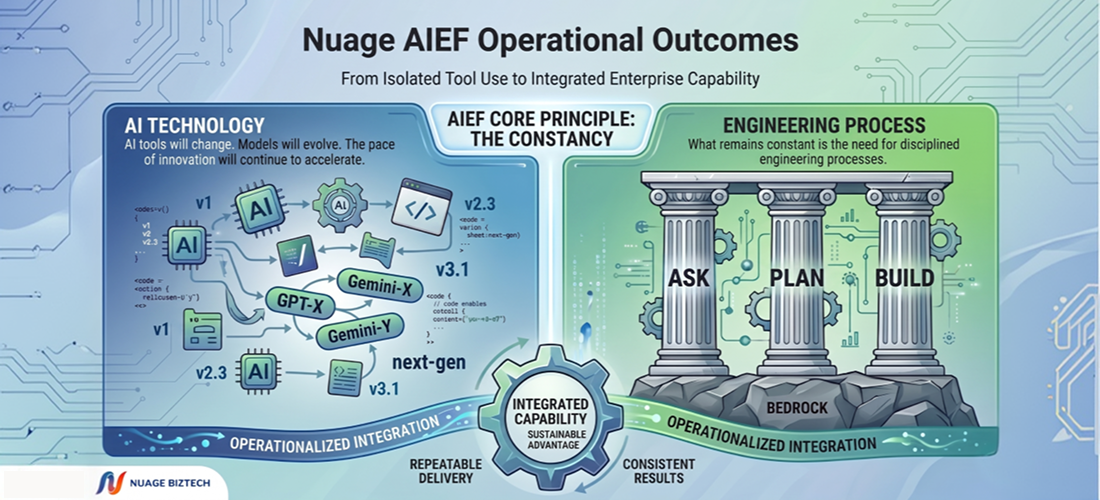
AI tools will change. Models will evolve. The pace of innovation will continue to accelerate. What remains constant is the need for disciplined engineering processes.
This realization ultimately led to the development of the Nuage AI Engineering Framework (AIEF). AIEF is not tied to a specific AI tool or model. It is designed to provide a consistent approach for integrating AI into engineering delivery, regardless of how the technology evolves.
At its core, AIEF is built around a simple operating model:
ASK
Understand before changing.
- System discovery and codebase understanding
- Dependency and impact analysis
- Architecture and integration review
- Security and compliance considerations
PLAN
Validate before building.
- Solution design and approach validation
- Risk and dependency assessment
- Release and implementation planning
- Governance and security reviews
BUILD
Accelerate with control.
- AI-assisted implementation
- Testing and quality assurance
- Documentation and knowledge capture
- Human review and deployment governance
The objective was simple: create a repeatable approach that allows teams to benefit from AI while maintaining consistency across projects, teams, and delivery environments.
In the process, we realized that the most important shift was not technological, but operational. AI stopped being viewed as a tool and became part of the engineering process. Organizations that focus only on AI adoption may achieve productivity gains; organizations that successfully integrate AI into their engineering operating model will create a sustainable advantage.
The future of AI-enabled engineering will not be defined by who adopts AI first. It will be defined by who operationalizes it most effectively.